
Pet portraiture constitutes one of the highest-converting custom order categories for polymer clay jewelers. Dog owners eagerly invest in customized stud earrings, charm pendants, and keychains that accurately depict their beloved companions. However, translating canine breeds into physical clay presents a formidable engineering challenge: unlike smooth geometric teardrops, dog anatomy features heavy textural variation, pronounced muzzle folds, floppy ears, and complex fur coats.
When makers attempt to capture breed characteristics by cramming dozens of tightly spaced detail lines into a digital vector cutter, the physics of polymer clay quickly exposes fatal flaws. If parallel fur ribs are positioned closer than 1.2mm apart, raw clay bridges across the gap, jamming the cutter and tearing the slab. Conversely, if facial features are overly simplified, a French Bulldog becomes indistinguishable from a generic cartoon pug.
In this comprehensive studio guide, we examine the mechanical design principles behind CutClay’s breed series (dogs_001 through dogs_030 and pets_001 through pets_008), establish critical spacing thresholds for fur lines and muzzle folds, and detail production workflows for high-contrast portrait finishing.
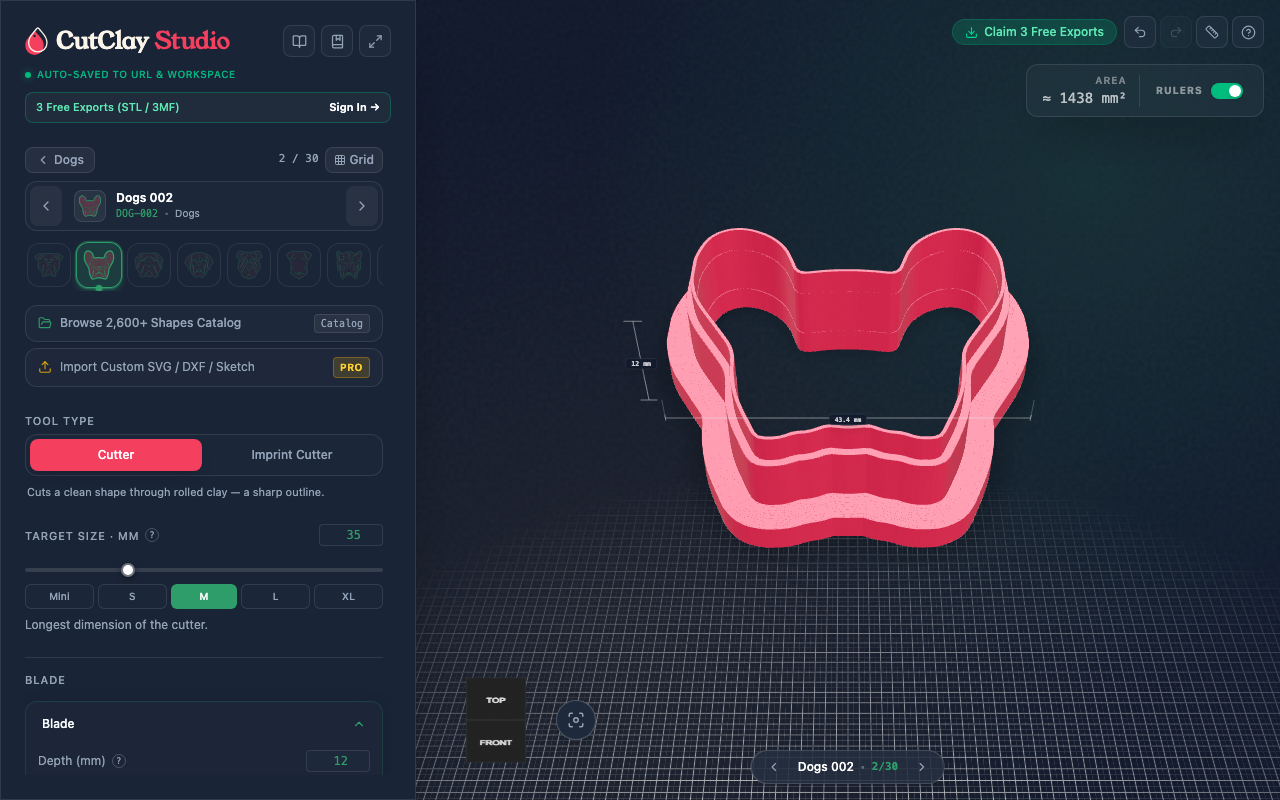
Anatomical Breed Standardization: Ears, Muzzles, and Proportions
Canine breeds diverge radically in cranial structure, falling generally into three major skull classifications: brachycephalic (short-muzzled breeds like French Bulldogs, Pugs, and Boxers), mesocephalic (medium-proportioned breeds like Golden Retrievers, Labradors, and Beagles), and dolichocephalic (long-muzzled sighthounds like Greyhounds and Whippets). In a miniature clay silhouette, conveying these breed markers requires precise handling of three primary anatomical landmarks:
- Ear Fold Architecture: Standing erect ears (such as the bat ears of
dogs_002or German Shepherds) must be braced with an expanded fillet radius at the skull junction (minimum R1.5mm) to prevent post-bake snapping. Flopped drop ears (Golden Retrievers, Dachshunds) must incorporate debossed shadow lines to separate the ear mass visually from the cheek without slicing through the clay slab. - Muzzle Volume Relief: Rather than cutting completely through the clay, the muzzle is defined by an internal 1.0mm debossed groove that frames the nose pad and jowls, maintaining a monolithic clay body.
- Nose Pad & Eye Anchors: Deep circular deboss registers provide intuitive paint wells that hold enamel or fluid acrylics securely during surface finishing.
The 1.2mm Fur Line Rule: Avoiding Clay Bridging
When modeling fur textures for long-haired breeds (such as Golden Retrievers, Collies, or Schnauzers), the temptation is to replicate individual hair strands with micro-ribs. In 3D printing and polymer clay stamping, this is mathematically counterproductive.
The cohesive strength of conditioned polymer clay causes it to behave as an elastic solid when compressed. If two parallel cutting or debossing ribs are separated by less than 1.2mm of open space, the clay squeezed between them cannot escape upward or sideways. Instead, it forms a mechanical bridge that welds itself into the cutter cavity. Upon lifting the tool, the clay tears completely away from the base piece.
In CutClay’s dog collection, all internal fur and fold lines enforce a strict minimum spacing of 1.20mm (preferably 1.50mm to 1.80mm on earrings over 30mm). Rather than drawing twenty individual hair strands, our vector profiles use clustered directional sweeps that indicate the flow of the coat while leaving broad, continuous clay land masses that release without tearing.
Explore these calibrated breed geometries directly in CutClay Studio for dogs_002 or browse all 30 breed silhouettes in the dog category catalog.
Parametric Dimensions for Canine Cutters
The following parametric values ensure robust cutter prints and clean, repeatable clay impressions:
| Parameter | Standard Dimension | Engineering Rationale |
|---|---|---|
| Overall Target Size | 30.0 mm – 35.0 mm | Optimal scale for statement stud earrings and necklace pendants |
| Minimum Rib Spacing | ≥ 1.20 mm | Eliminates clay jamming and edge tear-out between fur grooves |
| Ear Fillet Radius | ≥ R1.5 mm | Disperses stress concentrations where ears join the head |
| Muzzle Imprint Depth | 1.0 mm (1.2mm step-back) | Deep enough to hold acrylic paint wash without severing clay |
| Outer Blade Edge | 0.40 mm | Sharp double-taper extrusion for minimal post-cure sanding |
Slicer Profile: Preserving Facial Sharpness
When slicing pet portrait cutters, ensure that small internal detail features are not dropped by your slicer’s slicing engine:
| Slicer Setting | Optimal Configuration | Bench Outcome |
|---|---|---|
| Wall Generator | Arachne Engine | Dynamically modulates line width so fine muzzle ribs print solid |
| Layer Height | 0.12 mm – 0.16 mm | Maintains crisp vertical fidelity on interior facial steps |
| Wall Loops | 3 loops (0.4mm nozzle) | Ensures blade tip and interior ribs are 100% perimeter plastic |
| Detect Thin Walls | Enabled (if using Classic) | Prevents slicing omissions on fine whisker or fold paths |
| Top Surface Pattern | Concentric | Follows cutter perimeter for maximum structural seam strength |
Studio Finishing Protocol for High-Contrast Portraits
To produce distinctive custom breed portraits with deep graphic appeal, follow this studio finishing protocol:
- Clay Preparation: Condition firm clay (Fimo Professional or Kato Polyclay) to 2.8mm thickness. Working with chilled clay slabs significantly improves the crispness of fine muzzle grooves.
- Barrier Film Stamping: For breeds with complex wrinkles (such as French Bulldogs or Shar-Peis), place a sheet of ultra-thin cling wrap over the clay before stamping. Press firmly down. The film rounds the knife edge slightly, producing clean, organic skin folds that demold with zero residue.
- Curing: Bake supported on a bed of baking soda or polyfill batting to prevent flat spots on the back of the portrait head. Bake for 50 minutes at 130°C.
- Two-Tone Antiquing: Once cool, coat the entire cured portrait with diluted black or dark brown acrylic wash. Work the bristles deep into the muzzle lines, eyes, and ear folds. Gently buff the high surfaces with a slightly damp microfiber sponge. The debossed facial lines pop with intense contrast, transforming a single-color clay blank into a realistic, expressive breed portrait.
Ready to produce custom pet portraits for your customers? Open CutClay Studio to explore all dog breed cutters and export your 3D printer files instantly.