
Inlaying contrasting materials—such as glass cabochons, natural gemstone druses, crushed minerals, and crystal-clear UV resin pools—transforms ordinary polymer clay earrings into fine art jewelry pieces. Traditionally, creating a recessed bezel required tedious hand-gouging with woodcarving gouges or assembling multiple layered clay washers that inevitably shifted during baking.
When makers attempt to carve bezel recesses freehand, inconsistent depth leads to uneven resin pooling, unsightly meniscus overflow, and ill-fitting glass domes that pop loose over time. Furthermore, polymer clay undergoes measurable thermal and volumetric shrinkage during the oven curing cycle, causing pre-measured stones to sit awkwardly atop undersized cavities.
To eliminate these assembly bottlenecks, CutClay developed a dedicated family of bezel and cabochon frame cutters (catalog series cabochon_001 through cabochon_022 and complementary sunburst bezels celestial_030 through celestial_036). In this engineering guide, we examine the mechanics of stepped dual-depth cutting blades, calibrate cavity tolerances against polymer clay thermal contraction, and outline resin inlay techniques that guarantee permanent chemical and mechanical adhesion.
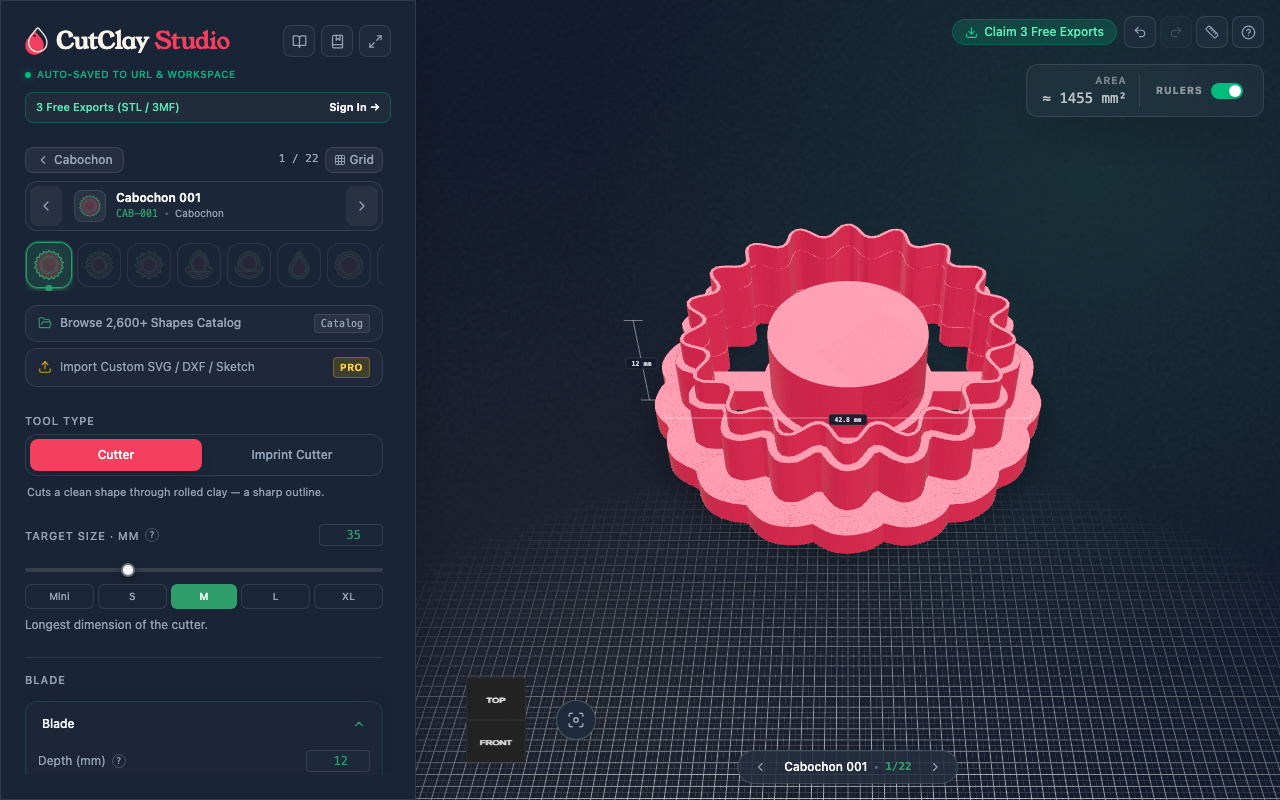
The Stepped Bezel Blade: Simultaneous Perimeter & Cavity Forming
A standard polymer clay cutter features a single cutting wall that slices entirely through the clay slab down to the working tile. A bezel frame cutter, by contrast, operates on a stepped dual-depth architecture:
- Outer Perimeter Cutting Blade: Features a full 12.0mm depth and a razor 0.4mm knife edge. It penetrates completely through a 3.0mm slab, establishing the outer ornamental silhouette (such as sunburst rays, scallops, or classic oval medallions).
- Inner Bezel Recess Wall: Features an offset blade depth of 10.5mm (a 1.5mm vertical step-back). When the tool is pressed until the outer blade seats flush against the work tile, the inner wall penetrates exactly 1.5mm into the slab, compacting and forming a perfectly flat-bottomed circular or oval recess with crisp 90° vertical containment walls.
Compensating for Volumetric Baking Shrinkage (1.5% to 2.0%)
Polymer clay consists of polyvinyl chloride (PVC) resin suspended in liquid plasticizers. As the piece bakes at 130°C–135°C, plasticizer molecules fuse permanently into the PVC matrix, expelling trace moisture and volatile components. This chemical fusion results in volumetric shrinkage ranging from 1.5% to 2.2%, depending on the clay brand (Premo contracts ~1.8%, Souffle ~1.5%, Fimo Professional ~2.0%).
If you design a bezel recess with an exact 10.0mm inner diameter to accept a commercially sourced 10.0mm glass cabochon, the baked clay cavity will shrink to approximately 9.82mm. The glass dome will fail to seat, floating awkwardly on the rim.
CutClay’s parametric cabochon models build in an engineered 2.0% diametric expansion factor. An intended 10mm cavity is printed with an internal blade diameter of 10.22mm. After baking and cooling, the cavity settles at exactly 10.02mm, providing a smooth sliding clearance fit (0.02mm tolerance) that seats pre-manufactured stones and glass cameos with vacuum-like precision.
Review these parametric tolerances in CutClay Studio for cabochon_001 or explore matching bezels in the cabochon category catalog.
Parametric Dimensions for Standard Cabochon Sizes
When selecting standard gemstone cabochons, match your CutClay cutter scaling to these verified specifications:
| Stone Nominal Size | Cutter Recess Diameter | Post-Bake Fit | Recommended Inlay Medium |
|---|---|---|---|
| 8.0 mm Round | 8.18 mm | 8.02 mm (flush) | Natural malachite, lapis, or opal cabochons |
| 10.0 mm Round | 10.22 mm | 10.03 mm (flush) | Clear glass photo cameos & dichroic glass |
| 12.0 mm Round | 12.25 mm | 12.04 mm (flush) | Direct-cast UV resin with botanical florals |
| 18 × 13 mm Oval | 18.38 × 13.26 mm | 18.05 × 13.04 mm | Vintage portrait cameos & crushed pyrite |
| Recess Wall Depth | 1.50 mm – 1.80 mm | Consistent floor | Provides mechanical anti-shear barrier |
3D Printing Slicer Profile: Zero-Defect Stepped Walls
When printing stepped cutters, the transition where the internal recess wall terminates must be completely free of stringing or plastic whiskers, which would imprint imperfections onto the clay bezel floor:
| Setting | Value | Studio Benefit |
|---|---|---|
| Retraction Distance | 0.8 mm (Direct Drive) / 5.0 mm (Bowden) | Prevents stringing between outer blade and inner ring |
| Layer Height | 0.12 mm | Produces silky-smooth cavity sidewalls that demold clean |
| Z-Hop When Retracting | 0.20 mm | Prevents nozzle collisions with the sharp recess edge |
| Cooling Fan Speed | 100% after layer 3 | Freezes PLA bridging instantly across internal overhangs |
| Print Temperature | 205°C (Standard PLA) | Slightly lower temperature minimizes oozing on fine blades |
Bench Inlay Protocol: Resin Curing & Zero-Bubble Domes
To cast flawless cabochon domes into your stamped polymer clay bezels, execute this bench workflow:
- Slab Thickness: Roll polymer clay to setting #0 on your pasta machine (3.5mm thick). This provides 1.5mm for the bezel floor and 2.0mm for the containment wall.
- Stamping the Cavity: Dust the cutter lightly with cornstarch. Press firmly downward until the outer blade makes full contact with the work tile. Lift straight up. The internal 10mm cavity will be cleanly formed with sharp 90° vertical edges.
- Initial Baking: Bake the clay piece completely before adding any resin (45 minutes at 130°C). Allow to cool to room temperature.
- Resin Pouring and Curing: Clean the recessed cavity with isopropyl alcohol. Using a high-viscosity jewelry UV resin, dispense drops into the center of the cavity until a gentle convex surface tension dome develops at the rim. Pass a lighter flame quickly over the surface to pop micro-bubbles. Cure under a 36W 365nm UV lamp for 120 seconds. The 90° clay rim traps the liquid resin securely, preventing meniscus leakage down the earring sides.
Open CutClay Studio to explore all cabochon and bezel cutters and start printing professional jewelry frames tonight.