
Cat silhouettes are perennial best-sellers in handmade artisan jewelry, yet they pose significant mechanical hazards on the clay artist’s bench. The feline anatomy is characterized by delicate, high-aspect-ratio appendages: whip-like tails, pointed ear tips, slender ankles, and fine whisker whiskers. When translated from a 2D digital drawing directly into polymer clay without structural adaptation, these features frequently tear inside the cutter blade, snap off during demolding, or break in the hands of the end customer.
To eliminate these chronic manufacturing defects, CutClay Studio recently completed a comprehensive overhaul of its feline catalog, curating exactly 41 distinct gestures (catalog series cats_001 through cats_041). Each shape has been mathematically conditioned to guarantee minimum cross-sectional thickness, clean demolding draft angles, and integrated surface engraving lines.
In this workshop guide, we dissect the physics of feline silhouette recognition, detail the mechanical rules governing tail and neck reinforcement, and establish optimal slicing parameters for printing clean cutters that release raw clay effortlessly.
The Physics of Clay Silhouette Recognition: 41 Curated Poses
A successful clay earring must be instantly recognizable from across a room. At standard earring scale (between 28mm and 40mm overall height), minor photographic details vanish. Visual recognition depends entirely on the negative space and characteristic postural silhouette of the animal.
CutClay’s 41 feline shapes cover the entire spectrum of iconic cat gestures, grouped into four distinct structural silhouettes:
- The Bread Loaf & Curled Sleeper (e.g.
cats_008,cats_012): Low center of gravity, zero protruding thin limbs, and smooth continuous exterior curves. These are the most durable shapes on the bench, ideal for stud earrings and everyday brooches. - The Arching Spine & Stretch (e.g.
cats_003,cats_019): Dramatic negative space under the belly that reads cleanly even in dark monochrome clay bodies like charcoal or terracotta. - The Upright Sitting Sentry (e.g.
cats_001,cats_025): Classic tall aspect ratio with the tail curled flush against the flank to create a self-supporting structural column. - The Playful Pounce & Stalk (e.g.
cats_015,cats_038): Dynamic forward angle balanced by thickened rear haunches to ensure structural rigidity during cutting.
Preventing Tail Fracture: The 1.8mm Rule & Draft Angles
In polymer clay physics, uncured PVC resin behaves like a non-Newtonian thixotropic paste. When an unreinforced cutter presses into a 2.5mm clay slab, friction against the cutter walls drags the raw clay downward. If an isolated feature (such as an extended tail) has an internal width under 1.8mm, friction exceeds the tensile cohesion of the clay, causing the tail to shear off inside the cutter cavity.
CutClay eliminates this failure mode through two geometric interventions:
- Flank-Tethered Curves: Whenever possible, tails are curved back toward the body, creating a continuous bridge rather than a cantilevered arm. Where free-floating tails are anatomically necessary, the root thickness is expanded to at least 2.2mm.
- External Draft Relief: While the knife tip maintains an ultra-sharp 0.4mm edge for the first 0.8mm of depth, the wall quickly steps outward at a 14° draft angle toward the 1.2mm secondary wall. This taper prevents trapped air from forming a suction vacuum when the cutter is lifted.
Calibrating Whisker & Eye Imprint Depths
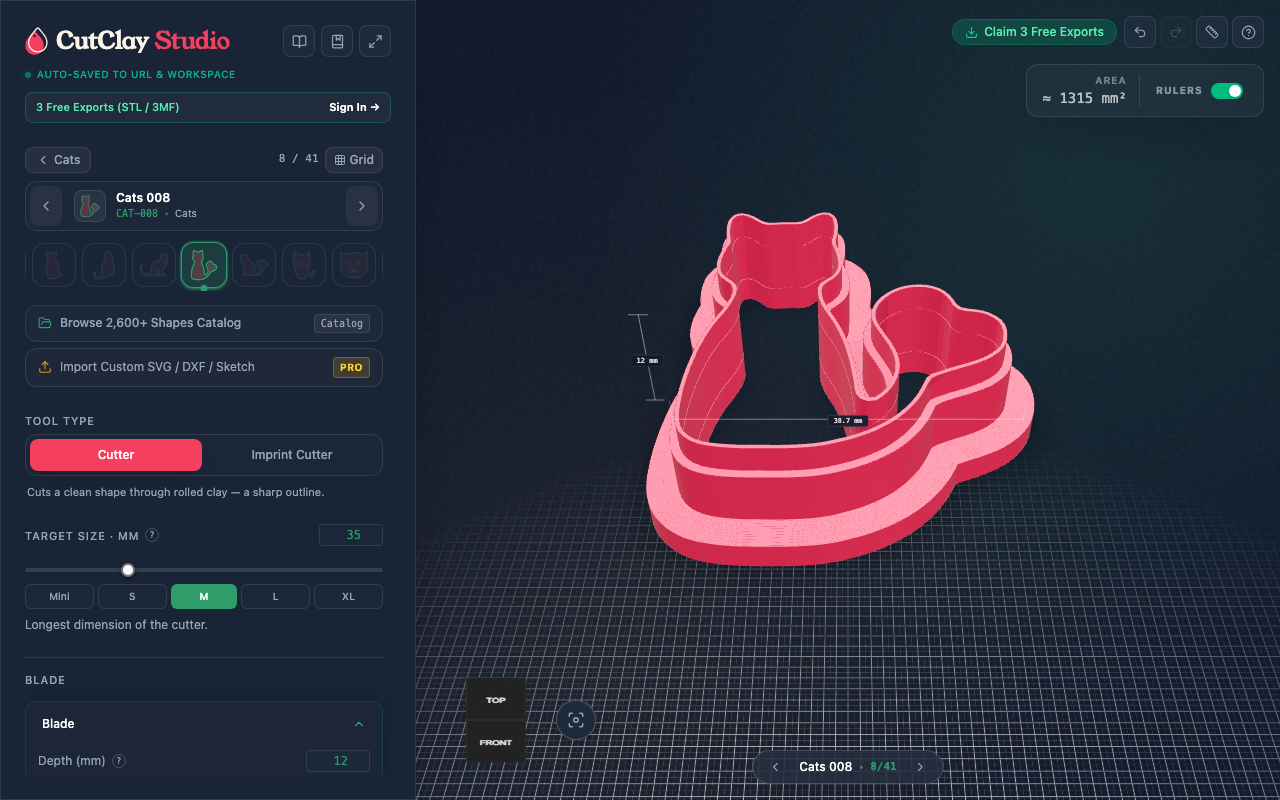
Many cat shapes in the series (including cats_008) feature interior surface engravings for eyes, nose bridges, and whiskers. If these interior blades are positioned at the same height as the outer cutting wall, they will chop the cat’s face into tiny loose clay fragments.
In CutClay Studio, internal imprint ribs are stepped back by a precise vertical offset. For a cutter with a 12.0mm total blade depth, the interior facial imprint ribs are set to 10.8mm, creating an exact 1.2mm relief gap. When you press the cutter into a 2.5mm clay slab until the outer blade touches your work tile, the facial details press exactly 1.0mm into the top surface of the clay—creating deep, crisp shadows without severing the structural clay substrate.
You can adjust these parameters in real time in CutClay Studio for cats_008 or explore all 41 poses across the cat category collection.
Parametric Dimensions for Feline Cutters
Use these verified bench dimensions when exporting cat cutters from CutClay Studio:
| Design Dimension | Recommended Value | Mechanical Benefit |
|---|---|---|
| Target Height (Stud) | 22.0 mm – 25.0 mm | Compact size fits comfortably on earlobes without tilting |
| Target Height (Dangle) | 34.0 mm – 40.0 mm | Preserves fine whisker lines and distinct negative space |
| Minimum Appendage Width | ≥ 1.8 mm | Prevents clay tearing and plasticizer deformation in the oven |
| Imprint Recess Step-Back | 1.2 mm offset | Yields 1.0mm debossed registers without cutting through slab |
| Wall Taper Draft Angle | 14° outward bevel | Releases sticky clay without suction vacuum pull |
3D Slicer Profile: Clean Edges on Intricate Contours
Because cat ears and paws involve abrupt directional changes, slicer acceleration and jerk settings must be tuned to avoid outer wall ringing artifacts. The following slicer settings are optimized for high-detail cutters:
| Setting | Value | Bench Purpose |
|---|---|---|
| Nozzle Size | 0.4mm (or 0.2mm for studs <20mm) | 0.4mm provides standard durability; 0.2mm delivers razor tip |
| Layer Height | 0.12 mm | Ultra-fine z-resolution ensures smooth wall slopes |
| Wall Line Count | 3 loops | Provides rigid reinforcement along narrow ear tips |
| Outer Wall Speed | 30 mm/s | Minimizes ghosting along high-frequency whisker curves |
| Seam Position | Sharpest Corner | Hides retract pips at the tail root or ear apex |
Studio Finishing: Inks, Acrylic Washes, and Demolding
When working with fine imprint lines, proper release technique makes the difference between a pristine cat face and a ruined slab:
- Cornstarch Dusting: Tap the cutter face into a small bowl of cornstarch, then tap the back of your hand to shake off excess powder. The thin microscopic layer prevents raw polymer clay from sticking to PLA layer lines.
- Straight Vertical Release: Place the cutter on the conditioned clay. Press down with steady two-handed pressure. Never wiggle the cutter laterally, as side-to-side motion widens the 0.4mm blade kerf and blurs whisker lines. Lift directly perpendicular to the tile.
- Antiquing Cured Imprints: After baking at manufacturer-recommended temperature (e.g. 135°C for 45 minutes on tile), allow the pieces to cool completely. Brush thin black or burnt umber acrylic paint across the debossed facial lines. Allow the paint to settle for 30 seconds, then wipe the top surface clean with a damp lint-free cloth or an isopropyl alcohol wipe. The dark pigment remains permanently trapped inside the debossed tracks, creating clean, illustrative graphic portraits.
Launch CutClay Studio to explore all 41 cat silhouettes and export clean STL cutters ready for your 3D printer.