
The transition into autumn marks the highest-volume retail sales quarter for handmade polymer clay jewelry. E-commerce storefronts and holiday craft markets see an enormous surge in demand for warm, earthy woodland aesthetics: textured acorn dangles, speckled forest mushrooms, harvest leaves, and miniature pumpkin drops. Yet producing hundreds of multi-piece autumn earrings places severe bottlenecks on standard studio assembly lines.
The two most common failure points during Q4 production runs are post-bake hole drilling and thin neck fractures. When makers manually drill 1.5mm holes through hundreds of cured acorn stems with a rotary pin vise, drills frequently wander off-center or blow out the back of the clay. Furthermore, on multi-part forest mushrooms, the delicate transition between the cap and the slender stem easily shears apart during demolding if cutter draft angles are too steep.
In this technical production guide, we analyze the structural engineering behind CutClay’s autumn and mushroom collections (catalog series autumn_001 through autumn_052 and mushrooms_001 through mushrooms_011), demonstrate the advantages of integrated 3.5mm jump-ring pin tubes, and detail the conditioning of rich autumn palettes that retain their saturation through extended baking.
Integrated Jump-Ring Tubes vs. Secondary Pin-Vise Drilling
In traditional jewelry production, pieces are stamped as solid blanks, baked in the oven, and then drilled by hand using a handheld pin vise or Dremel rotary tool. While acceptable for one-off hobby pieces, secondary drilling on production batches of 100+ earrings introduces unacceptable defects:
- Drill Bit Wander: Handheld bits drift along smooth cured clay, resulting in crooked or off-center holes that cause earrings to hang tilted on the earlobe.
- Rear Breakout Crater: As a standard twist drill exits the back of cured clay, it frequently punches out an irregular conical chip, requiring tedious sanding or UV resin repair.
- Labor Inefficiency: Manual drilling adds between 30 and 45 seconds of labor per earring component. Across a 200-pair market inventory, that represents over five hours of repetitive physical labor.
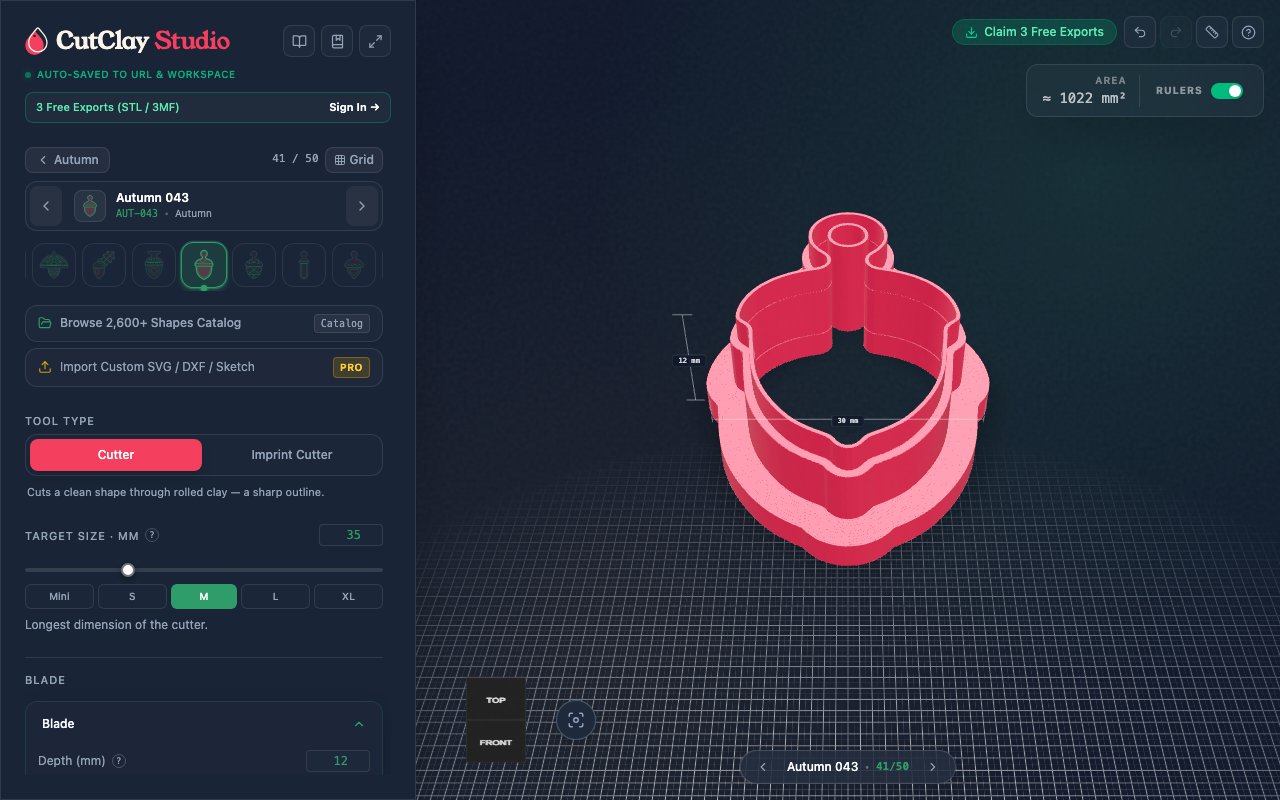
CutClay resolves this bottleneck by integrating a dedicated hole-cutting tube directly into the 3D-printed cutter body (as seen in autumn_043). A hollow 1.6mm internal diameter cylindrical blade, surrounded by a minimum 3.5mm outer reinforcement wall, punches a clean, perfectly vertical hole through the raw slab during the initial stamping stroke. When you lift the cutter, the clay plug is retained inside the tube or falls free onto the tile, leaving a polished, circular hole with zero exit tear-out.
Textured Lattice Cap Geometry: Acorns & Mushrooms
In nature, an acorn cap features a rough, overlapping shingled cupule, while forest mushrooms feature gills or textured speckles. In polymer clay design, recreating these textures by hand with needles on every single acorn is impossibly slow.
In CutClay’s autumn collection, cap textures are engineered into the cutter as a secondary relief lattice:
- Lattice Rib Depth: The crosshatched diamond lattice ribs on acorn caps are stepped back 1.1mm above the primary outer blade edge. When pressed into a 2.8mm slab, the lattice debosses an exact 0.9mm deep diamond texture into the acorn cap without cutting through the clay.
- Cap-to-Nut Transition Groove: A bold horizontal divider rib (1.2mm depth) establishes a crisp physical boundary between the textured cap and the smooth nut below, making it effortless to paint the cap dark brown or dust it with bronze powder while keeping the nut a clean warm amber.
You can inspect and customize these features in CutClay Studio for autumn_043 or explore all matching autumn designs in the autumn category catalog.
Parametric Dimensions for Autumn Collections
Use these baseline parametric values when configuring acorn, mushroom, and harvest cutters in CutClay Studio:
| Design Dimension | Recommended Dimension | Production Advantage |
|---|---|---|
| Overall Drop Length | 32.0 mm – 38.0 mm | Strikes ideal visual balance for autumn dangle sets |
| Integrated Hole Diameter | 1.60 mm | Fits standard 16-gauge (1.2mm) and 18-gauge (1.0mm) jump rings |
| Hole Wall Margin | ≥ 3.50 mm solid clay | Eliminates ring tear-out under earring movement |
| Cap Lattice Imprint Depth | 0.90 mm | Produces crisp diamond texture that holds antiquing waxes |
| Mushroom Neck Fillet | ≥ R2.0 mm | Reinforces slender stem against bending fatigue |
3D Slicer Configuration: Strong Small Cylinders
When printing cutters with integrated 1.6mm hole tubes, print settings must be dialed in to ensure the small plastic cylinder does not snap under stamping pressure:
| Slicer Setting | Value | Technical Impact |
|---|---|---|
| Minimum Layer Time | 8 seconds | Allows small hole cylinder to cool before next layer deposits |
| Fan Speed | 100% constant | Freezes PLA overhangs and fine lattice details instantly |
| Wall Loops | 3 loops (0.4mm nozzle) | Ensures hole punch tube is 100% solid perimeter plastic |
| Outer Wall Speed | 30 mm/s | Maintains circular concentricity on the punch cylinder |
| Filament | PLA+ or PETG | High interlayer adhesion prevents hole tube delamination |
Studio Production Protocol for Autumn Collections
Streamline your studio production runs with this batch-tested bench protocol:
- Color Conditioning: Formulate custom autumn hues using professional clay bases (Premo or Cernit). Blend raw sienna with cadmium red for rich terracotta, Spanish olive with ecru for muted sage, and cadmium yellow with burnt umber for harvest mustard. Roll sheets to 2.8mm thickness.
- Single-Stroke Punching: Dust the cutter lightly with cornstarch. Press straight down onto the slab with firm palm pressure, ensuring both the outer silhouette and internal hole tube penetrate through to the ceramic tile. Lift cleanly. The component is 100% cut and pre-drilled in a single motion.
- Mushroom Speckling: For fly agaric mushroom caps, roll micro-balls of white clay and gently press them into the red clay cap before stamping with the mushroom cutter. The cutter slices through both colors simultaneously, embedding the speckles flush with the cap surface.
- Full Baking Schedule: Bake on ceramic tiles at 135°C (275°F) for 50 minutes. Extended baking is critical for rich autumn colors, ensuring that plasticizers fully cross-link and prevent brittle fracture around the jump-ring hole.
- Hardware Assembly: Connect pre-punched components using 6mm 16-gauge raw brass jump rings. The clean, pre-drilled 1.6mm hole allows jump rings to swing freely with natural movement.
Explore CutClay Studio to browse the entire autumn and mushroom collection and ramp up your studio’s holiday inventory today.