
Coastal and maritime jewelry enjoys universal, year-round popularity across coastal resort boutiques and summer jewelry markets. The ocean offers a mesmerizing vocabulary of organic forms: undulating manta rays, spotted eagle rays, Portuguese Azulejo ceramic fish, textured sea scallops, and nautical brass motifs. Yet maritime shapes frequently introduce severe hydrodynamic and mechanical challenges into 3D-printed clay cutters.
The primary manufacturing obstacle in sea life cutters centers on extreme wingtip and fin geometry. Marine creatures like the Spotted Eagle Ray (sea_079) possess sweeping pectoral wings that taper down to acute, razor-sharp tips. If a cutter wall is extruded vertically without generous draft relief, raw polymer clay wedges tightly into the wingtip crevices during the stamping stroke. Upon lifting the tool, the clay wingtips tear off completely or stretch into distorted triangular nubs.
In this technical studio manual, we examine the hydrodynamic and CAD architecture of CutClay’s marine catalog (catalog series sea_001 through sea_107 alongside nautical series nau_001 through nau_015), detail the mandatory 18° wingtip draft relief angle, and outline ceramic glazing and brass hardware techniques that yield museum-caliber marine jewelry.
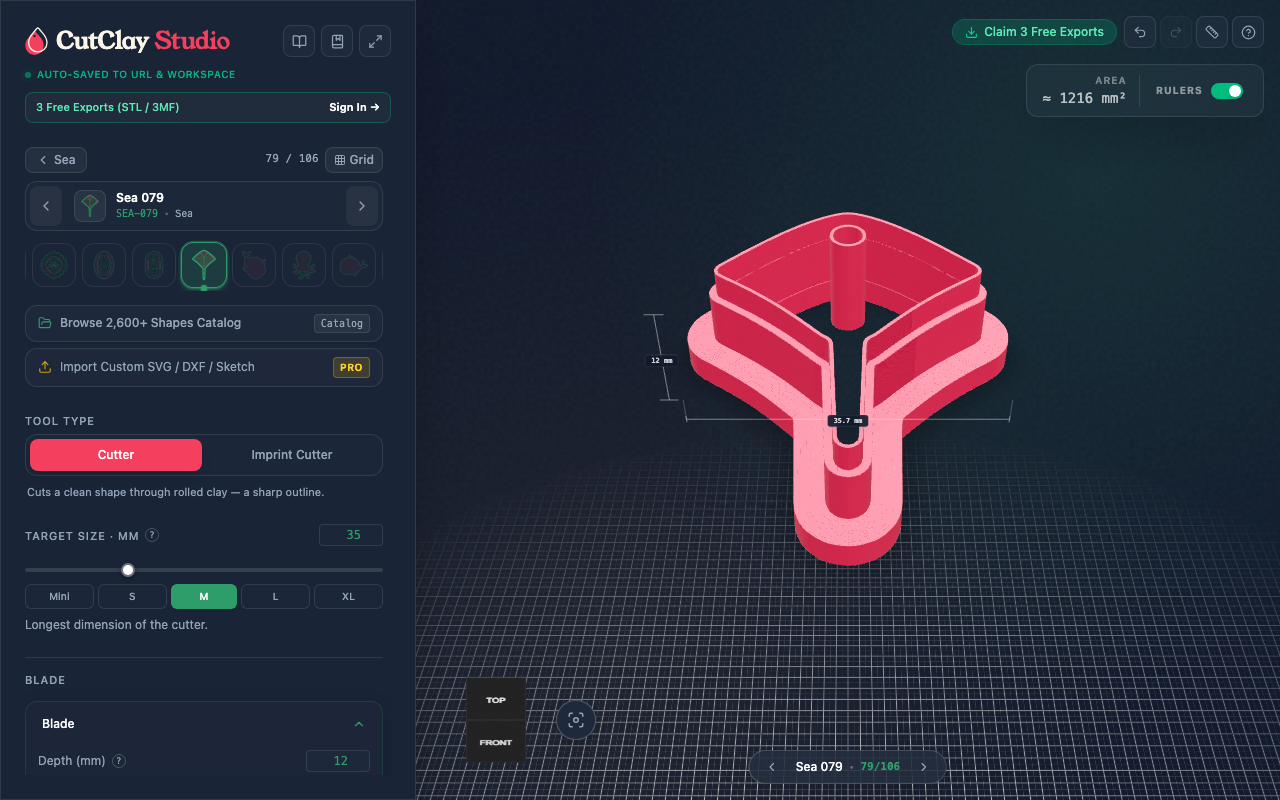
Pectoral Wing Mechanics: The 18-Degree Draft Relief Rule
A ray’s wings taper progressively from a thick central spinal disc down to an apex angle of less than 20° at the lateral wingtips. In traditional metal cookie cutters, this sharp angle is bent from thin tin sheet, leaving an open wedge that clogs after a single cut. In 3D-printed cutters, the microscopic layer ridges on adjacent inner walls create massive cumulative friction.
When the maker presses into a 2.5mm clay slab, clay is compressed into the narrow wingtip wedge. If the wall is perpendicular (90° to the tile), the frictional force required to pull the cutter off the clay exceeds the tensile strength of the unbaked PVC matrix, causing the wingtip to break off inside the tool.
CutClay eliminates this failure mode on sea_079 through an engineered 18° compound draft angle:
- First Tier (0.8mm Blade Tip): Features a sharp 0.40mm cutting knife edge that penetrates the slab cleanly.
- Second Tier (Draft Taper): Immediately above the knife edge, the wall expands outward at an 18.0° incline. This dramatic draft angle ensures that the moment the cutter is raised just 0.5mm, the tool’s inner surfaces break contact with the clay, completely eliminating wall friction and suction.
- Filleted Wingtip Apex: Rather than ending in an impossible microscopic point, the wingtip apex is terminated with an R0.5mm circular fillet that leaves a smooth, rounded tip on the clay blank.
Azulejo Ceramic Fish & Maritime Enamel Techniques
In addition to organic rays, CutClay’s maritime series features traditional Portuguese Azulejo tile fish (e.g. sea_012 through sea_025). These shapes incorporate geometric cross-hatchings and cobalt floral medallions that replicate hand-painted Mediterranean ceramic tiles.
When stamped into pure white or cream polymer clay, the debossed tile grooves serve as ink wells. After baking, brushing cobalt blue or turquoise alcohol ink over the surface and buffing with a dry felt pad leaves deep, vibrant blue patterns inside the debossed tile lattice, creating the visual illusion of glazed Mediterranean earthenware.
Inspect the detailed contour lines of sea_079 in CutClay Studio or explore all 107 marine shapes across the sea category collection.
Parametric Dimensions for Marine Cutters
Use these verified bench dimensions when exporting sea life cutters from CutClay Studio:
| Design Dimension | Recommended Dimension | Mechanical Benefit |
|---|---|---|
| Wingspan (Eagle Ray) | 36.0 mm – 42.0 mm | Graceful statement earring width with balanced weight (<5g) |
| Wingtip Draft Angle | 18.0° outward bevel | Prevents clay tearing at acute lateral wing apexes |
| Tail Filament Margin | ≥ 2.20 mm | Eliminates brittle whip-tail breakage during demolding |
| Dorsal Spot Deboss | 0.80 mm depth | Holds acrylic dot painting or mica powder highlights cleanly |
| Blade Cutting Edge | 0.40 mm | Double-taper profile minimizes sanding along sweeping curves |
3D Slicer Profile: Clean Extrusions on Narrow Wingtips
When printing cutters with sharp lateral wingtips, acceleration and flow control must be tuned to avoid under-extrusion at the acute apexes:
| Slicer Setting | Value | Bench Result |
|---|---|---|
| Wall Generator | Arachne Engine | Adjusts line width continuously into the 18° wingtip apex |
| Layer Height | 0.12 mm | Ensures high vertical resolution along the sloping draft angle |
| Wall Loops | 3 loops (1.2mm total) | Guarantees solid structural reinforcement behind the blade |
| Jerk / Corner Acceleration | 8 mm/s | Prevents directional overshoot on the acute wing points |
| Infill Density | 25% Gyroid | Resists crushing under heavy downward thumb pressure |
Studio Finishing Protocol: Coastal Jewelry Assembly
Follow this multi-step bench protocol to finish marine jewelry collections:
- Slab Conditioning: Formulate coastal ocean hues by blending deep ocean navy with white and pearl clay to create rich sea-foam marbling. Roll sheets to 2.5mm thickness on a ceramic tile.
- Stamping and Release: Dust the cutter with cornstarch. Align and press straight down with firm, balanced palm pressure. Lift directly upward without rocking. Thanks to the 18° draft angle, both wingtips release completely intact.
- Baking and Curing: Bake on a flat ceramic tile at 135°C (275°F) for 45 minutes to achieve maximum plasticizer cross-linking and structural flexibility in the thin wingtips.
- Hardware Integration: Pair your cured clay rays and Azulejo fish with nautical raw brass findings—scallop shell ear studs, textured brass sea-star charms, and thick 16-gauge twisted brass jump rings. The warm metallic luster of brass creates an exquisite contrast against ocean blue and sea-glass polymer tones.
Explore CutClay Studio to view all 107 marine and sea life shapes and design stunning coastal collections for your jewelry brand.