
Botanical and foliage motifs constitute the backbone of contemporary artisan jewelry collections. From tropical Monstera deliciosa leaves and fan-shaped Ginkgo biloba foliage to delicate eucalyptus sprays and four-leaf lucky clovers, botanical silhouettes appeal to nature lovers across all demographics. Yet botanical earrings frequently suffer from severe structural weaknesses at the cutter level: slender leaf tips tear upon demolding, fenestration slits pinch shut, and deeply embossed vein ribs slice entirely through thin clay slabs.
The primary engineering challenge in botanical clay cutters lies in managing acute angles and through-cut slit geometry. In nature, a Monstera leaf features deep, narrow fenestrations that narrow down to needle-sharp points. If a 3D-printed cutter attempts to replicate these needle points with parallel 0.4mm blades, the raw clay wedged inside the slit tears away from the stem when the tool is lifted. Furthermore, real leaves are rarely flat; their beauty derives from subtle parabolic arching and delicate vascular venation.
In this technical studio manual, we examine the mechanical rules governing CutClay’s botanical catalog (catalog series leaves_001 through leaves_030 and botanica_001 through botanica_042), establish the mandatory 2.7mm minimum rounded slit radius on fenestrations and clover lobes, and detail surface dusting workflows using mica pearl luster powders and matte botanical washes.
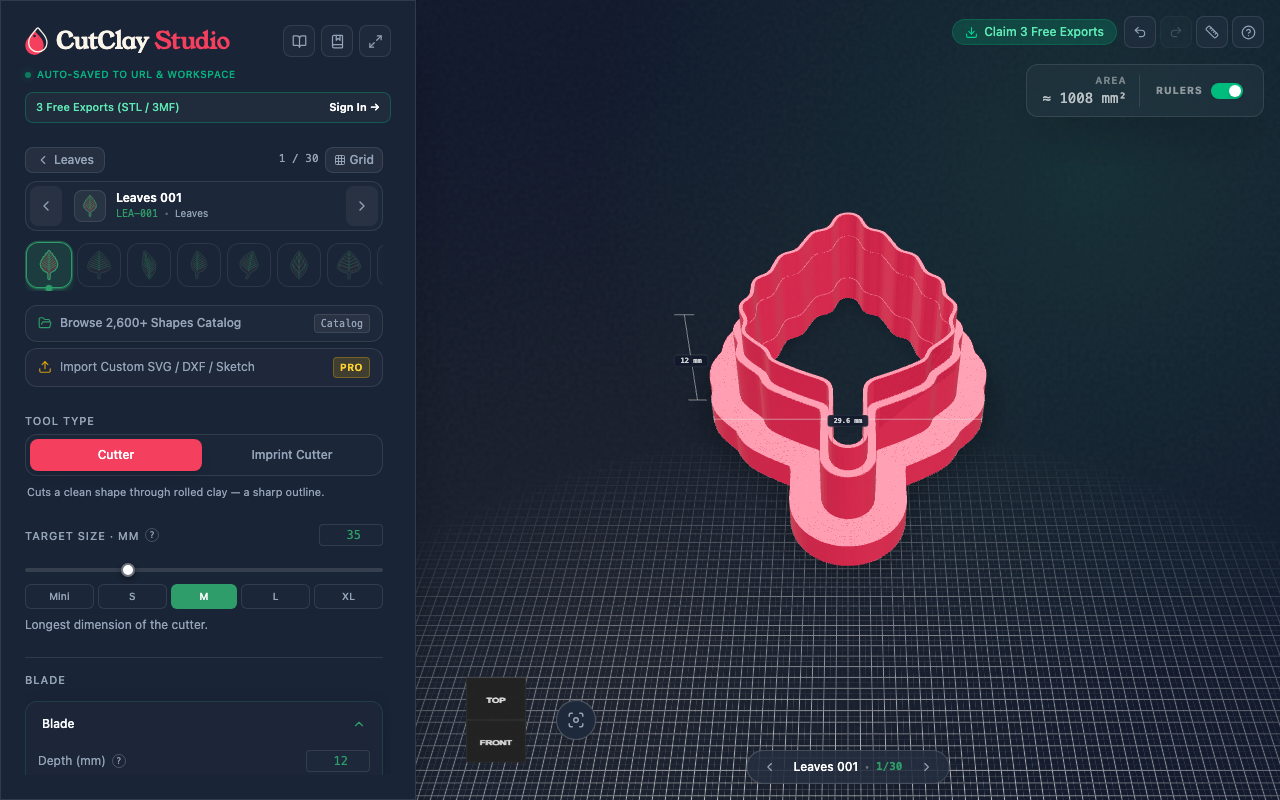
Tear-Free Fenestration Geometry: The 2.7mm Slit Rule
In Monstera leaves and segmented palm fronds, the leaf body is divided by through-cut slits that extend from the outer perimeter deep into the central midrib. When a maker presses a traditional cutter into clay, the narrow tongue of clay formed between two adjacent cuts is subjected to extreme tensile shear stress during extraction.
If the inner terminus (the root) of a leaf slit comes to an acute sharp V-point, stress concentrates precisely at the apex of the V. As the cutter is withdrawn, friction against the cutter walls pulls the leaf lobe upward, causing a stress tear that propagates along the midrib.
To eliminate this failure mode, CutClay enforces strict geometric rules across all botanical shapes (including clover series botanica_039 through botanica_042):
- Engineered Root Radii: Every slit terminus terminates in a smooth, circular fillet with a diameter of at least 2.70mm. This rounded radius distributes extraction forces evenly around a broad curve, eliminating stress concentration points.
- Slit Channel Flare: Rather than running parallel, fenestration channels flare open toward the outer perimeter at a 7° angle. This expansion allows the clay leaf tongue to release immediately without wall friction.
Vascular Venation Architecture: Stepped Midrib & Lateral Veins
In addition to outer perimeter silhouettes, realistic botanical jewelry requires delicate surface veins. However, if vein ribs are molded at full cutter blade height, they act like internal axes, chopping the leaf into five or six separate pieces.
In CutClay’s botanical collection, vascular venation is engineered as a two-tier deboss structure:
- Primary Midrib: Anchored to the upper frame with an imprint depth of 1.0mm (stepped back 1.0mm above the 0.4mm outer perimeter blade). The midrib features a continuous 0.6mm wide rounded profile that debosses a strong central spine into the clay.
- Secondary Lateral Veins: Branch outward at 45° angles with an imprint depth of only 0.6mm (stepped back 1.4mm). These finer secondary veins create subtle light-catching highlights without compromising the cross-sectional strength of the leaf.
Inspect the vascular architecture of leaves_001 in CutClay Studio or explore all 30 botanical variants across the leaves category collection.
Parametric Dimensions for Botanical Foliage Cutters
When generating botanical cutters in CutClay Studio, standardizing on these dimensions ensures consistent earring durability:
| Design Dimension | Standard Benchmark | Production Rationale |
|---|---|---|
| Overall Leaf Length | 35.0 mm – 44.0 mm | Graceful drape on dangles without brushing the shoulders |
| Slit Root Fillet Diameter | ≥ 2.70 mm | Prevents tear propagation along deep fenestrations |
| Stem Connection Width | ≥ 3.20 mm | Provides ample material for a 1.6mm jump-ring drill hole |
| Primary Midrib Imprint | 1.0 mm depth | Defines central vascular spine on 2.5mm slabs |
| Secondary Lateral Veins | 0.6 mm depth | Delicate surface texture that holds luster powders |
3D Slicer Profile: Zero-Stringing Across Open Fenestrations
Because leaf cutters feature deep cutouts that divide the tool body into multiple thin fingers, rigid retraction settings are essential to prevent filament stringing inside the fenestration cavities:
| Slicer Setting | Optimal Value | Bench Result |
|---|---|---|
| Retraction Distance | 0.8 mm (Direct Drive) / 4.5 mm (Bowden) | Eliminates spiderweb stringing between adjacent leaf lobes |
| Layer Height | 0.12 mm | Produces smooth, continuous curved blade walls |
| Wall Loops | 3 loops (1.2mm total) | Provides rigid stiffness on narrow fenestration blade walls |
| Seam Position | Stem / Base | Hides start/stop pips where they will be covered by jump rings |
| Print Speed (Outer Walls) | 28 mm/s | Maintains crisp geometric accuracy around the 2.7mm root fillets |
Studio Finishing Protocol: Mica Powders and Parabolic Cupping
To produce botanical earrings that look organic rather than stamped out of flat sheet plastic, execute this studio finishing protocol:
- Clay Conditioning: Condition sage green, olive, or forest translucent clay to 2.5mm thickness. Work on a glossy ceramic tile to anchor the slab firmly during stamping.
- Stamping and Lifting: Dust the cutter lightly with cornstarch. Press straight down, using your palm to apply equal pressure over both the outer perimeter and the central midrib. Lift directly upward. The leaf remains flat on the tile.
- Pre-Bake Parabolic Cupping: Peel the raw leaf gently off the tile using a flexible tissue blade. Place the leaf inside a curved hollow (such as a miniature silicone half-sphere mold or a piece of crumpled aluminum foil). Gently curve the leaf edges upward to create natural three-dimensional cupping. Real leaves are curved, not flat.
- Mica Powder Highlighting: Before baking, dip a soft eyeshadow brush into gold or interference green mica pigment powder. Lightly dust across the raised vascular midrib and curved leaf margins. The mica adheres permanently to the raw polymer matrix during curing.
- Bake and Seal: Bake for 45 minutes at 135°C. Once cooled, drill a 1.4mm hole at the leaf stem, at least 3.0mm from the top edge. Seal with a satin polyurethane varnish or leave with a matte natural finish.
Explore CutClay Studio to view all botanical leaf cutters and bring natural organic elegance to your jewelry bench.