
Twisted rope borders and Celtic braided knots hold an esteemed place in classical goldsmithing and nautical jewelry design. When rendered in polymer clay, a braided rope frame provides rich organic texture, catching light across its diagonal ridges while creating a handsome framed window for contrasting stone cabochons, scenic landscapes, or negative-space skin reveals. Yet despite their timeless visual appeal, twisted rope frames represent one of the most mechanically troublesome geometries to produce with 3D-printed clay cutters.
The engineering challenge stems from two conflicting factors: concentric wall suction and diagonal rib asymmetry. A hollow rope frame requires cutting both an exterior scalloped border and an interior window cutout simultaneously. If the interior clay core forms an airtight seal against the cutter’s center wall, atmospheric pressure creates a vacuum upon lifting, stretching and distorting the delicate 3.0mm rope ring. Furthermore, true twisted ropes have chirality—a right-handed twist (Z-twist) must be paired with a true left-handed twist (S-twist) to create balanced, symmetrical statement earrings.
In this technical studio guide, we examine the CAD architecture of CutClay’s rope and knot catalog (catalog series rope_001 through rope_010 and knots_001 through knots_009), detail the pairing of mirrored chiral twins like rope_001 and rope_008, and outline vacuum-relief techniques that guarantee pristine hollow frames on every press.
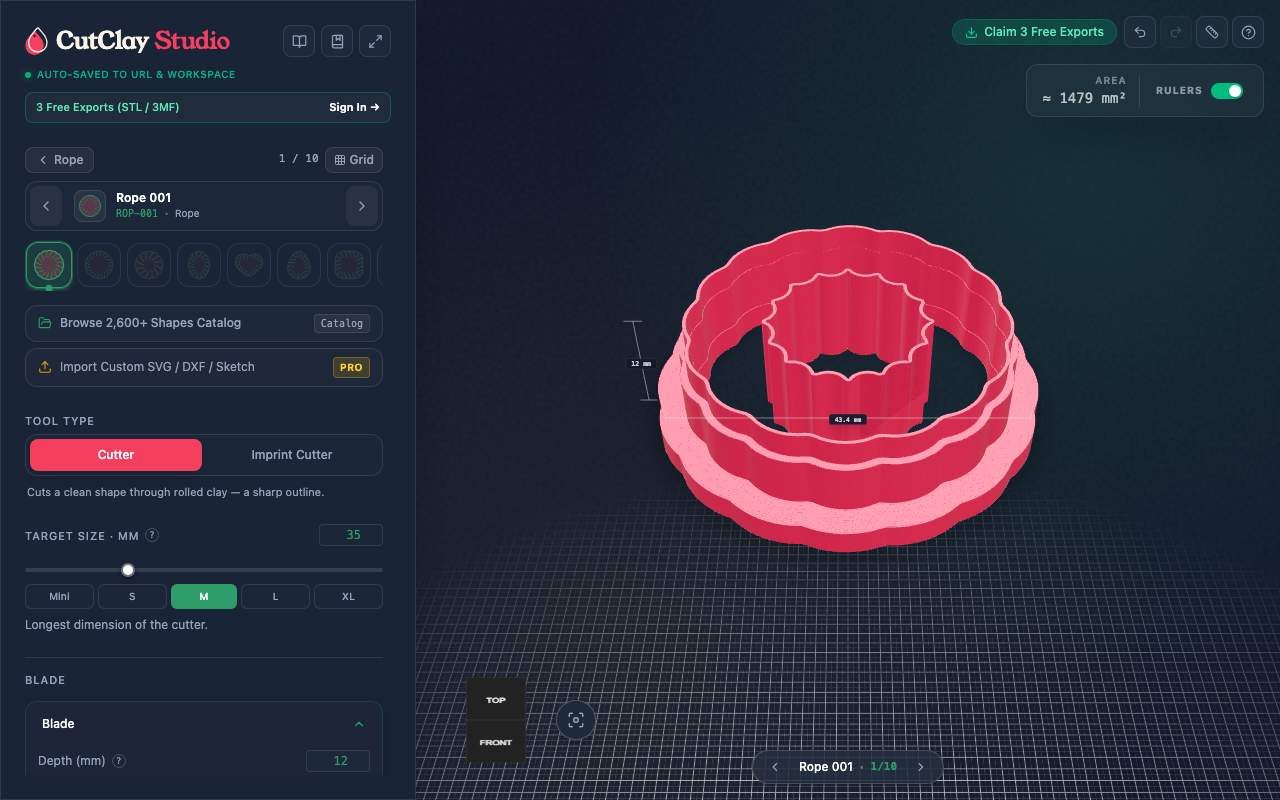
Chirality in Earring Design: Right-Twist vs. Left-Twist Pairs
In commercial jewelry design, symmetry across the wearer’s face is paramount. If an artist cuts two identical right-twisted rope frames from a single cutter and hangs them as a pair of earrings, one earring will spiral toward the jawline while the other spirals away from it. To high-end buyers, this subtle visual asymmetry looks unbalanced and unfinished.
CutClay solves this problem by engineering balanced chiral companion shapes across the rope catalog:
- Right-Handed Twist (Z-Twist, e.g.
rope_001): The rope strands spiral upward and to the right at a 38° helix angle, creating a strong clockwise visual dynamic. - Left-Handed Twist (S-Twist, e.g.
rope_008): The mathematical mirror image ofrope_001, spiraling upward and to the left at the identical 38° counter-clockwise helix angle.
By stamping one blank with rope_001 and the matching blank with rope_008, makers produce a harmoniously mirrored pair of earrings that frame the wearer’s jawline with classical architectural balance.
Concentric Window Mechanics: Eliminating Vacuum Suction
When cutting a closed hollow frame (such as an oval or teardrop with a large central opening), the cutter possesses two independent knife blades: the outer scalloped rope blade and an inner concentric window blade. If both blades are perfectly vertical, air trapped inside the central core cannot escape during the downward stroke.
When the maker attempts to lift the cutter, the air pressure underneath the tool drops, creating an atmospheric suction cup. This vacuum force pulls the delicate 3.0mm clay frame upward, warping the wet clay and stretching the oval out of round.
CutClay eliminates this destructive vacuum through two geometric features:
- Opposed Draft Angles: The outer rope blade tapers outward at 14°, while the inner window blade tapers inward toward the center at 12°. This creates a wedge profile that breaks contact with both clay faces the instant the cutter lifts a fraction of a millimeter.
- Continuous 3.0mm Frame Land: The distance between the inner and outer blades is strictly maintained at a minimum of 3.0mm throughout the entire 360° path, ensuring the clay ribbon possesses adequate tensile strength to withstand demolding without elongation.
Inspect and rotate the 3D geometry of rope_001 in CutClay Studio or explore all nautical braided frames across the rope category catalog.
Parametric Dimensions for Hollow Rope Frames
Use these baseline parametric values when configuring rope and knot frames in CutClay Studio:
| Design Dimension | Calibrated Value | Operational Role |
|---|---|---|
| Overall Outer Height | 36.0 mm – 42.0 mm | Generates substantial visual impact with minimal cured weight (<6g) |
| Minimum Frame Wall Width | ≥ 3.00 mm | Prevents hoop distortion and tensile sagging during baking |
| Rope Strand Scallop Depth | 0.80 mm – 1.10 mm | Captures deep shadows under light without trapping clay in roots |
| Central Window Clearance | ≥ 14.0 mm width | Provides ample space for floating charms or stud drop connections |
| Opposed Inner Draft Angle | 12° inward taper | Eliminates atmospheric vacuum suction during cutter lift |
3D Slicer Profile: Clean Slicing of Concentric Rings
Because rope frame cutters feature concentric exterior and interior blades, travel moves must be carefully managed to avoid stringing across the central opening:
| Slicer Setting | Configuration | Bench Result |
|---|---|---|
| Avoid Crossing Perimeters | Enabled (Max Detour 50mm) | Keeps travel moves inside the solid flange; zero strings across blade |
| Layer Height | 0.12 mm | Renders smooth, continuous scallop peaks on the 38° rope spiral |
| Wall Loops | 3 loops (0.4mm nozzle) | Ensures both inner and outer blades are solid plastic rings |
| Seam Placement | Rear / Inner Concave | Places retraction points inside the window where they won’t show |
| Print Material | Tough PLA or PLA Pro | High rigidity prevents concentric blade flexing during firm presses |
Bench Protocol: Cutting and Finishing Hollow Rope Frames
Follow these studio steps to achieve crisp, distortion-free hollow rope frames:
- Slab Conditioning: Roll polymer clay to 2.8mm thickness. Working directly on a high-gloss ceramic tile ensures the clay adheres firmly to the tile during cutting, preventing the hollow frame from lifting off the work surface with the cutter.
- Stamping Technique: Dust the cutter with cornstarch. Align the cutter and press straight down. Apply balanced two-thumb pressure directly above the concentric inner and outer walls. Never rock the cutter back and forth.
- Removing the Center Slug: Lift the cutter straight up. The hollow rope frame will remain firmly anchored to the tile. Using a curved needle tool or dental explorer, gently hook the central waste clay slug and lift it out.
- Baking on Flat Tile: Bake the frame directly on the ceramic tile for 45 minutes at 135°C. Leaving the frame undisturbed on the tile eliminates any sagging or warping that occurs when transferring raw hollow shapes.
- Metallic Patina Accent: After baking and cooling, apply gold or bronze mica wax (such as Rub ‘n Buff) with a fingertip across the raised diagonal rope ridges. The deep valleys remain dark clay, producing a realistic antiqued metallic braided jewelry finish.
Open CutClay Studio to explore all rope and knot cutters and create balanced mirrored earring collections for your brand.