
Walk into any contemporary artisanal jewelry boutique or search bestselling polymer clay drops on Pinterest, and you will notice a decisive shift away from rigid geometry toward fluid, asymmetric silhouettes. Often called The Organic Pebble, abstract bean, or river stone, these freeform shapes sell well because they look like natural stone and feel hand-sculpted.
Yet for 3D printmakers and clay artists, asymmetrical organic contours introduce unique fabrication challenges that traditional CAD tools struggle to solve:
- Concave Waist Distortion: When offsetting an undulating curve, many CAD programs accidentally shorten or collapse the inner concave waist, distorting the intended silhouette.
- Center of Gravity Balance: Because the shape is asymmetrical, placing a hanging post hole off-center causes the finished earring to tilt awkwardly on the earlobe.
- The Symmetrical Framing Problem: Wearing two identical asymmetrical shapes looks unbalanced. An organic earring pair must be cleanly mirrored so each drop frames the wearer’s jawline harmoniously.
In this fourth tutorial of our Shape Series, we demonstrate how to configure an organic pebble cutter in CutClay Studio, balance its hanging center, and export mirrored pairs with zero mesh defects.
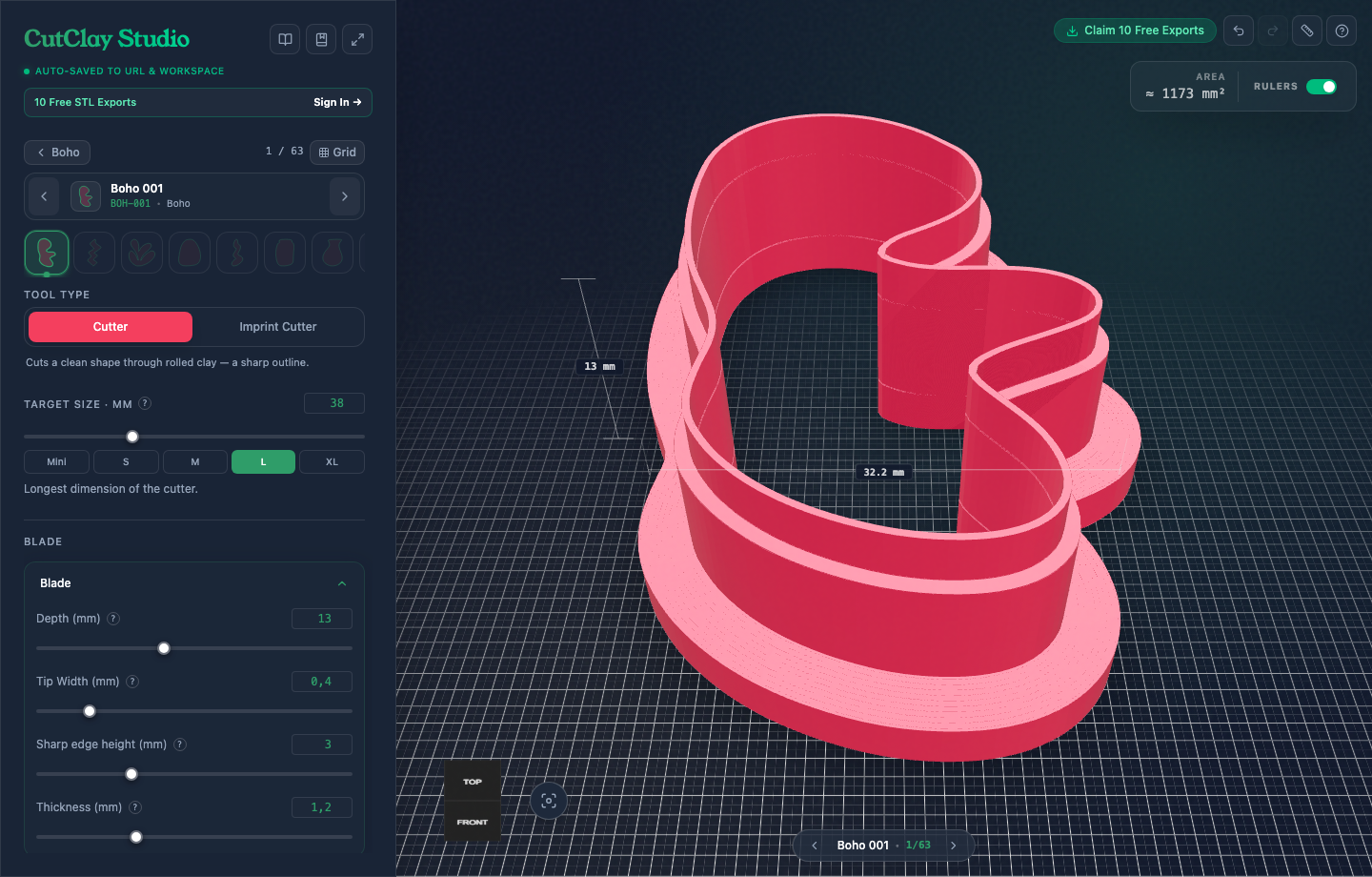
Step 1: Selecting the Organic Contour & Scale
Open CutClay Studio with Boho 001. The studio renders the organic silhouette in real-time 3D with millimeter dimension callouts.
Under Cutter Size, choose your target scale:
- 38 mm – 42 mm: The ideal proportion for an organic statement drop. The asymmetrical curve creates visual movement without overwhelming the neck.
- 28 mm – 32 mm: Subtle everyday dangles, perfect for pairing with textured terrazzo or granite clay slabs.
- 16 mm – 20 mm: Modern organic stud earrings that sit snugly against the earlobe.
Step 2: Dual-Wall Geometry for Undulating Curves
Freeform curves require careful wall engineering. If the blade wall is uniform and thin, the narrow concave waist will flex when pressed into dense clay; if it is too thick, clay drags and tears along the curves:
- Tip Width:
0.4 mm— A precise, single-perimeter cutting edge that glides through unbaked polymer clay without dragging or displacing soft surface details. - Blade Thickness:
1.2 mm— Provides rigid structural mass behind the cutting tip. This ensures the undulating curves hold their exact geometry when slicing into cold, firm clay slabs (such as Kato, Premo, or Fimo Professional). - Blade Depth (Height):
13.0 mm— Gives generous vertical clearance so your knuckles and fingertips never make contact with the clay surface. - Sharp Edge Height:
3.0 mm— The vertical length of the 0.4 mm blade before the taper smoothly widens into the 1.2 mm reinforced wall.
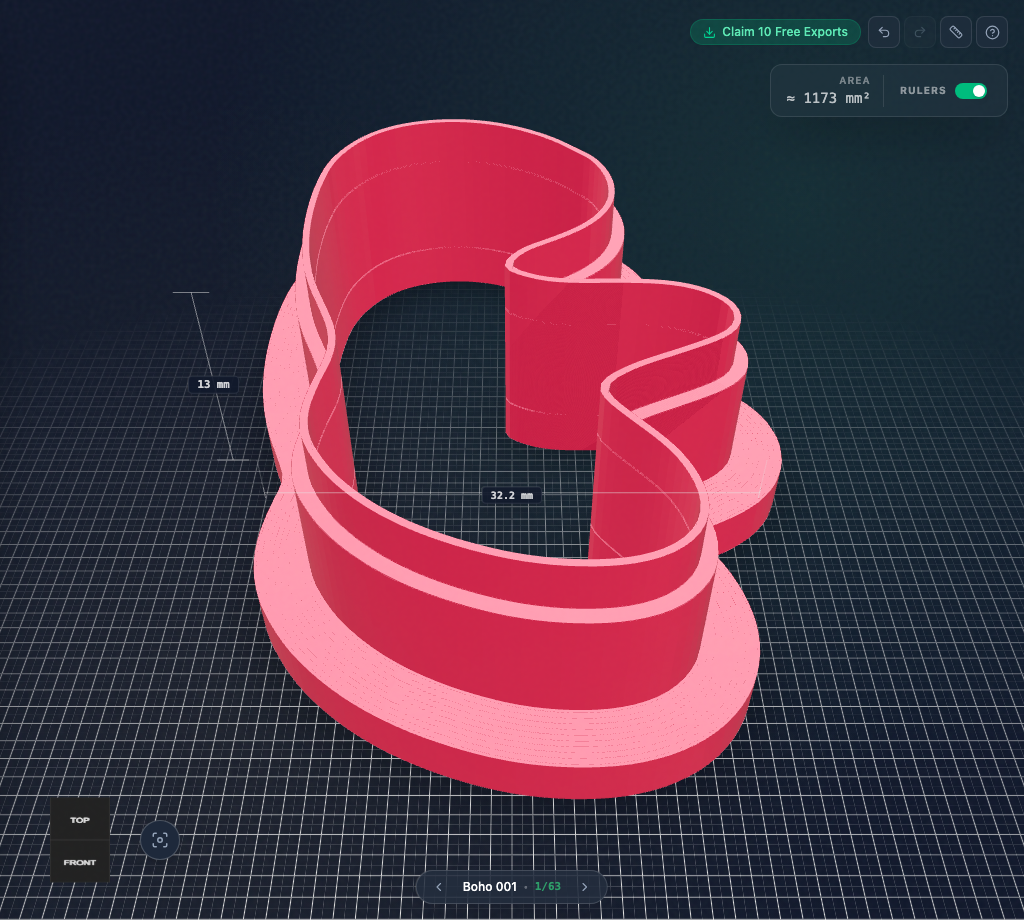
Step 3: Preserving the Inner Profile (Outward-Only Offsets)
A cardinal rule of quality cutter design is that the inner cutting edge must remain 100% faithful to the vector contour. CutClay’s CAD engine expands all wall reinforcements, tapers, and handles strictly outward.
Notice how even in the tight, concave waist of the pebble, the inner cutting edge never cuts corners, introduces bridge segments, or rounds off inward. You get the exact artistic shape you designed on paper, every single time.
- Handle Width:
3.0 mm— Generous outer brim for comfortable, painless palm pressing. - Handle Height:
3.0 mm— High structural rigidity that resists bending or delamination across thousands of studio cuts.
Step 4: Exporting Symmetrical Mirrored Pairs
When working with asymmetrical silhouettes, never cut both earrings with the same tool orientation. Wearing two earrings that face the same direction creates an unbalanced, tilted look.
In CutClay Studio, simply enable Mirrored Pair Mode. The engine instantly computes a mathematically inverted copy with matched clearances and exports both tools together in a single click.
Instant Boho Pebble Template Link:
Load this exact 38mm Organic Pebble cutter template directly in your browser:
Launch the 38mm Boho Pebble Cutter Template in CutClay Studio →
Step 5: 3D Slicer Settings for Organic Contours
Undulating organic curves look best when printed with smooth layer transitions:
| Setting | Recommended Value | Reason |
|---|---|---|
| Layer Height | 0.16 mm | Ensures smooth, step-free curvature on organic slopes |
| Wall Loops / Perimeters | 3 walls | Creates a 100% solid blade body without hollow gaps |
| Wall Order | Inner / Outer | Improves dimensional accuracy of the sharp outer cutting tip |
| Print Orientation | Base flat on build plate | Cutting edge points vertically upwards |
| Material | PLA+ or PETG | High rigidity and low thermal warping |
Studio Tips: Releasing Clay from Concave Curves
Because the narrow waist of a pebble cutter can pinch soft clay, use these three studio techniques to achieve clean separation every time:
- The Vertical Lift Rule: Always pull the cutter straight up. Tilting the cutter sideways while extracting will wedge clay into the concave waist and tear the edge.
- Chill Soft Slabs: If your clay feels overly pliable or sticky (common with fresh Soufflé or Sculpey Premo on warm days), place your rolled slab in the refrigerator on a ceramic tile for 5 minutes before cutting. Firmer clay releases instantly without residue.
- Dusting the Perimeter: A quick dusting of cornstarch or baby powder along the cutting edge creates a microscopic barrier that prevents friction in the narrow waist.
Conclusion
Asymmetric organic pebble shapes offer high artistic value, and they give a handmade line a natural, sculptural look.
Explore the Boho and Organic shape families and generate your own custom cutters in CutClay Studio.